Ask a front-desk manager what a hotel key card “knows” about a guest and you will often hear the same worry that has circulated since the early 2000s: that the card stores names, home addresses, or credit card numbers. It does not. The most-cited examination of this claim, a review of 100 used key cards drawn from different properties, found nothing but functional data on them, and the police warning that started the rumor was later formally retracted. What actually lives on a modern hotel key card is a short encoded identifier, and the security of your property depends far less on that data than on which chip you put it on.
What a hotel key card actually stores
On a well-designed system the card holds an encoded credential, typically a unique identifier tied to a room and a valid date range, and little else. The decision to open a given door is made by the lock and the access-control backend, not by the card volunteering personal details. Reputable integrators follow a simple rule: access rights should never live solely on the card. The card presents a credential, the reader authenticates it, and the property management system governs what that credential is allowed to do. That is why a lost card is a minor event rather than a data breach, and why the “your card has your identity on it” story never held up to inspection.
The practical takeaway is that data-on-card is not your risk surface. Cloning is. A card that can be silently copied lets someone reproduce a working credential, and whether that is possible comes down entirely to the chip generation you specified the last time you reordered.
The chip generation is the whole security story
Hotel cards operate at one of two radio frequencies. Low-frequency 125 kHz cards and simple “UID-only” high-frequency cards carry no meaningful encryption and are trivial to duplicate; they belong on loyalty punch cards, not guest room doors. The industry standard for room access is 13.56 MHz high-frequency, and within that band the chip family matters enormously.
MIFARE Classic, still shipping on huge volumes of cheap cards, relies on a proprietary cipher called Crypto-1 with a 48-bit key. Crypto-1 was reverse-engineered and publicly broken more than fifteen years ago, and the attacks have only gotten faster since. MIFARE DESFire EV2 and EV3, by contrast, use AES-128 with hardware tamper resistance and mutual authentication, meaning the card and reader each prove their identity before any data moves. MIFARE Plus in SL3 mode is a common middle path for properties upgrading in stages. The chart below shows why key length alone already tells much of the story, though it is not the only factor.
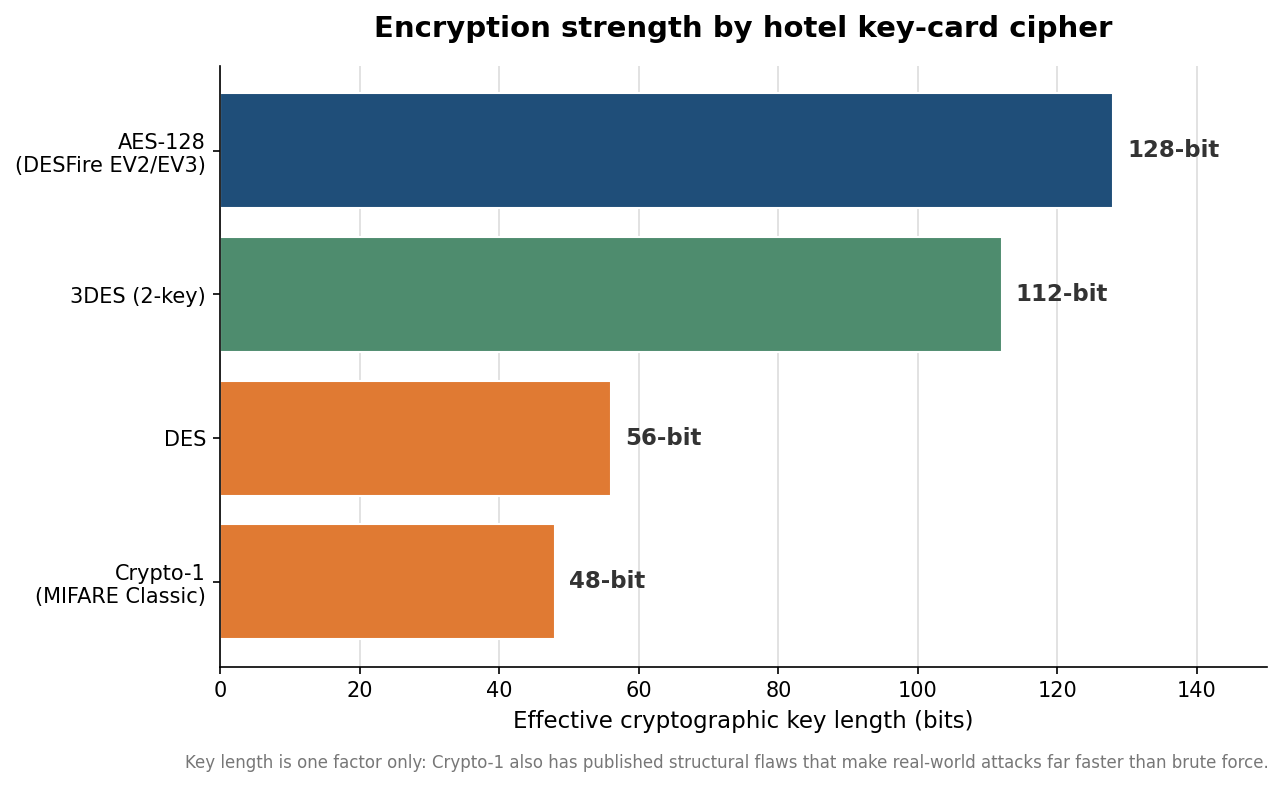
The gap between a 48-bit proprietary cipher and AES-128 is not incremental. AES-128 is considered computationally unbreakable for the purposes of door access, while Crypto-1’s weaknesses are structural rather than just a matter of short keys, which is why a determined attacker does not need to brute-force anything at all.
How cloning actually happens
The realistic attack on a weak card is not someone reading it from across the lobby. It is brief physical proximity. Inexpensive tools that have circulated for years, from Proxmark units to consumer NFC gadgets, can read a vulnerable MIFARE Classic card in seconds when held close to it, recover the keys through well-documented cryptographic attacks, and write a working duplicate onto a blank. That is the entire threat model, and it is also why the short read range of 13.56 MHz cards is a feature rather than a limitation.
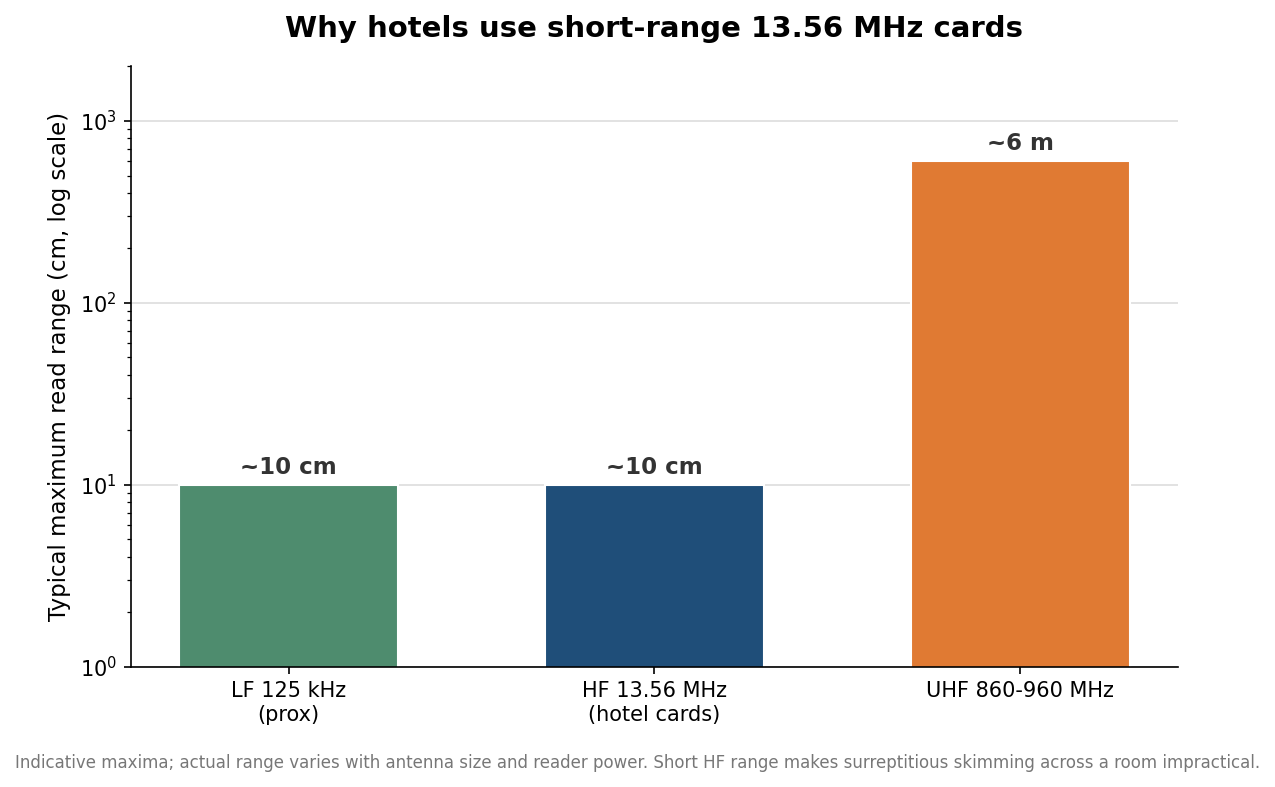
A hotel card is designed to be read only when it is almost touching the reader. That short range, on the order of a few centimeters, is deliberate: it makes surreptitious reading from a bag or a nearby seat impractical. Long-range UHF tags, which can be read from several meters, are excellent for pallet tracking and completely wrong for a guest door. If a supplier ever proposes a “convenient” long-range card for room access, treat it as a red flag.
What to specify when you reorder
Because the card itself is a commodity, the specification is where security is won or lost, and it costs little more to get it right. Ask for MIFARE DESFire EV2 or EV3, or MIFARE Plus in SL3 mode if your locks are not yet ready for full DESFire, and confirm the locks and encoders on your property actually support that chip before ordering in volume. Insist that each property use its own diversified keys rather than a shared factory default, so that a credential lifted at one location cannot be replayed at another. Confirm that cards are encoded at the property against your access-control system rather than pre-loaded with standing access rights. None of this changes what the guest sees; it changes whether a copied card is useful to anyone.
On cost and lead time, expect the more secure chips to carry a modest premium. Plain printed or low-security 13.56 MHz cards often sit at the bottom of the range, while DESFire EV2/EV3 stock runs higher per unit; as an indicative figure custom encrypted RFID cards commonly fall somewhere in the region of a few tens of cents to well over a dollar each depending on chip, print, and order size, with minimums frequently in the low hundreds. Those numbers move constantly with chip supply and volume, so treat them as a planning band rather than a quote, and price the security tier you actually need rather than defaulting to the cheapest card on the shelf.
The bottom line for operators
The old fear was aimed at the wrong thing. Your guests’ personal data is not on the card, and never sensibly was. What is on the card is a credential whose value to a thief depends entirely on whether it can be copied, and that is a decision you make at the purchase order, not at the front desk. Specify a modern encrypted chip, use diversified keys, keep access logic in the backend, and the humble plastic rectangle stops being a security question and goes back to being a branding one.