A hotel key card is only as useful as the lock it opens. Order a beautiful full-color card with the wrong chip inside and you have a stack of branded plastic that will not release a single door. Because the card has to speak the same radio language as your locks, matching the technology is the part of the order that actually determines whether the cards work — the printing is the easy part. Here is how to specify a card that your existing locks will accept, and what the real differences between card types mean for security, capacity, and cost.
Two frequencies, and only one talks to modern locks
Contactless key cards operate at one of two radio frequencies, and they are not interchangeable. Low-frequency 125 kHz (LF) cards use older chips such as EM or Temic and are typically found on legacy systems or as a step up from magnetic-stripe locks that are being phased out. High-frequency 13.56 MHz (HF) cards, governed by the ISO/IEC 14443 standard, are the mainstream for modern smart locks and are where the encryption and multi-application capability live. A 125 kHz card will not open a 13.56 MHz lock, and vice versa, so the first question to answer before you order anything is which frequency your locks read. If your property still swipes magnetic-stripe cards, note that magstripe is a contact technology entirely separate from both RFID frequencies, and moving to contactless usually means a lock upgrade, not just new cards.
If you are staying on magnetic stripe for now, one spec still matters: coercivity. High-coercivity (HiCo) stripes, rated around 2,750 to 4,000 oersted, resist accidental erasure from phones, bag clasps, and other magnets far better than low-coercivity (LoCo) stripes at roughly 300 oersted, which is why hotels almost always specify HiCo despite the small added cost. It is a common and avoidable mistake to order cheap LoCo stock and then field a wave of demagnetized cards at the front desk.
The chip inside decides security and capacity
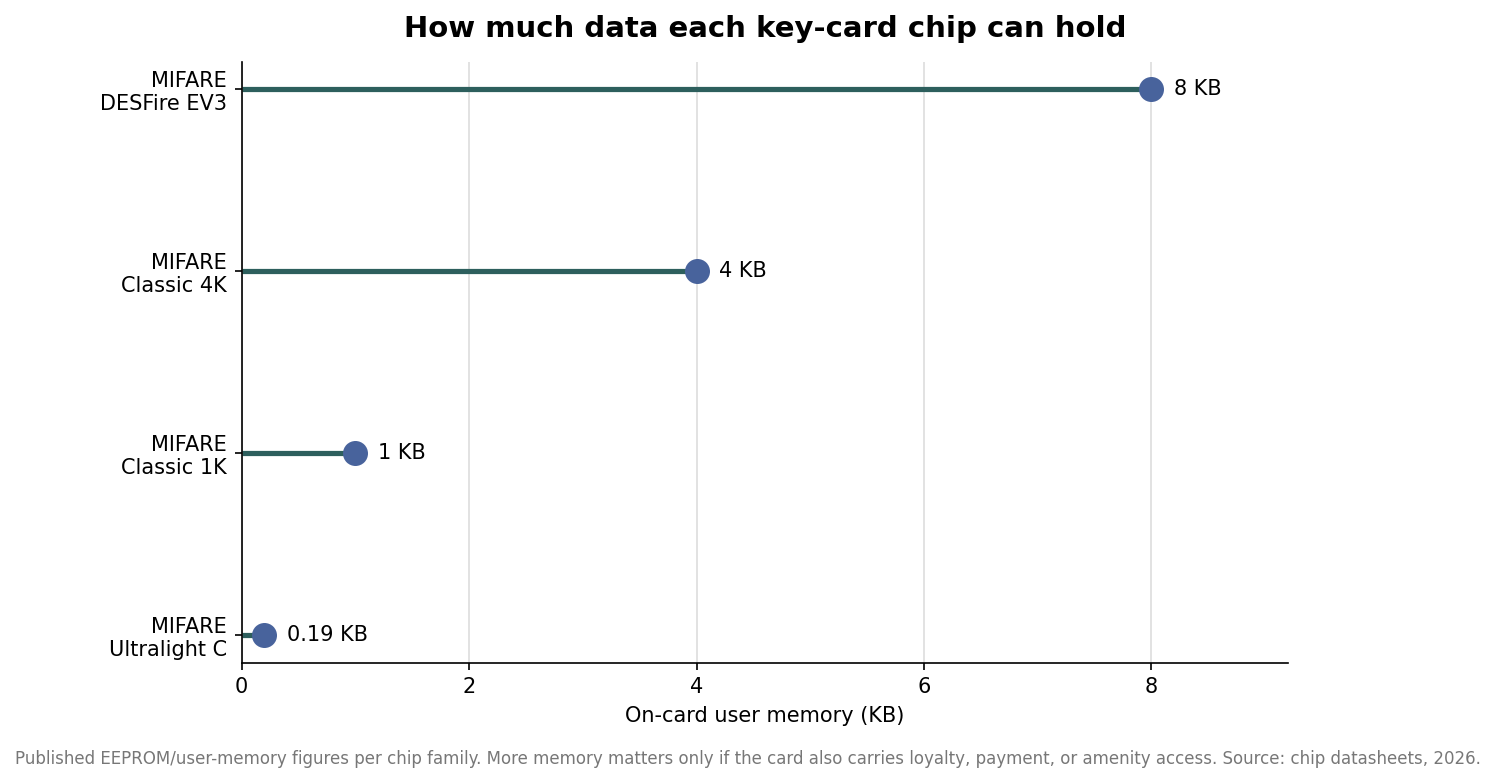
Within the 13.56 MHz world, the specific chip matters. MIFARE Classic (1K or 4K) is the long-established workhorse and the cheapest smart option, but its original Crypto-1 cipher has well-documented security limitations, which is why security-conscious properties increasingly specify something stronger. MIFARE Ultralight C is a low-memory, low-cost chip often used for disposable or short-stay cards. MIFARE DESFire (EV1 through EV3) uses modern AES-128 encryption and is the choice for higher-security installations and for cards that do more than open a door. Memory scales with the chip too: an Ultralight C holds a couple of hundred bytes, a Classic 1K holds about a kilobyte, and a DESFire EV3 can hold up to eight, which only matters if the card also carries loyalty, payment, elevator, or amenity access.
Match the card to your lock ecosystem
Lock manufacturers each publish which chips their readers accept, and the safe path is to match your order to that list rather than to a generic “RFID card” description. Broadly, Dormakaba and Saflok systems accept MIFARE Classic (Mini, 1K, 4K), MIFARE Plus, and Ultralight C. Onity and Miwa systems similarly read MIFARE Classic, Plus, and Ultralight families. Salto offers the broadest compatibility, reading DESFire, Classic and Ultralight variants, plus non-MIFARE technologies such as HID iCLASS Seos and LEGIC. VingCard (Assa Abloy) installations are predominantly 13.56 MHz MIFARE as well. Brand names and firmware versions change what a given lock accepts, so treat these as starting points: confirm the exact chip and memory your model requires with your lock supplier, and if you are buying “compatible with Saflok/Onity” cards, verify the frequency and chip family, not just the brand label.
What it costs, and how to order without a misfire
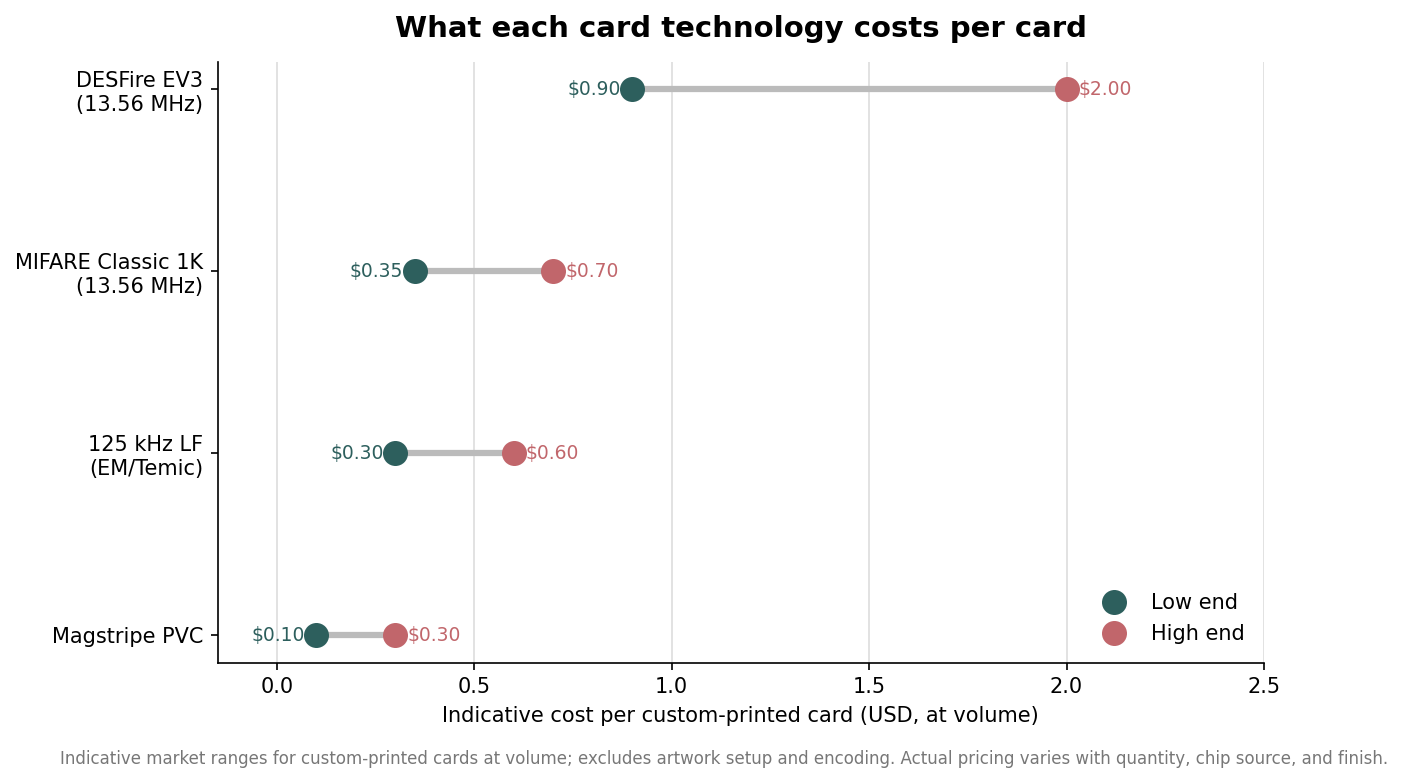
Card technology drives most of the per-card cost. A plain magnetic-stripe PVC card is the cheapest option, low-frequency cards sit a little higher, MIFARE Classic is the affordable smart standard, and DESFire commands a real premium for its encryption. Those chip costs sit on top of the printing, which is roughly the same regardless of what is inside. There is also the encoding question: some suppliers ship blank-but-chipped cards that your property management or lock system encodes on site, while others can pre-encode to your specification — clarify which you need, because a correctly chipped card that is not encoded for your system still will not open a door on arrival. It also pays to ask how the lock reads the card: some systems key on the chip’s unique ID (UID) alone, while others write and read data in the card’s protected memory sectors. That distinction rarely changes what you order, but it determines whether cards can be re-encoded and reused for the next guest or are effectively single-assignment, which in turn changes how many you need to keep in rotation.
Test one card before you print a thousand
Every hotel key card, regardless of chip, is built on the same physical standard: a CR80 card, 85.6 by 54 millimeters, 0.76 millimeters (30 mil) thick, which is why they fit every standard printer, wallet, and lock slot. That uniformity is exactly why it is easy to order the right size with the wrong insides. The single most reliable safeguard is a physical test: before committing to a full run, have your supplier send a small sample of the exact chip and encoding you intend to buy, and try it in your actual guest-room lock. If it opens the door cleanly and holds up to a few dozen taps, you have confirmed the one thing that a spec sheet cannot fully guarantee. Only then approve the artwork, the finish, and the full quantity. A single test card is a trivial cost against the alternative of a pallet of cards that greet your guests with a red light.